

Skip to Content Skip to Navigation

Lights, Camera, Action!

Read about the new varieties that will arrive in garden centers for the first time in 2010.

Contributors: Kerry Meyer

Read about the new varieties that will arrive in garden centers for the first time in 2010.

Another year and another new batch of exciting Proven Winners® plants are poised to hit the market.  Here is your sneak peek of the first half of the new plants.  If you are interested in learning more about where new plants come from, click this link.  Without further ado, let's get to the fun stuff.

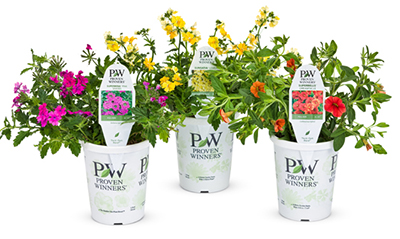
Many of you are probably already familiar with Superbells® Calibrachoa; they have been on the market since 2004.  This year, we are introducing two new colors; Superbells® Yellow and Superbells® LavenderSuperbells® Yellow is bright yellow in the traditional Superbells® mounded, trailing habit.  The large flowers and dark green foliage create a striking plant - a great choice for use in brightly colored flower combination pots.

Superbells® Lavender has soft lavender blooms on slightly more upright plants than the traditional habit, however, the plants still trail and will make beautiful hanging baskets.  Whereas Superbells® Yellow has large flowers, Superbells® Lavender flowers are a bit more petite, but with the multitude of blooms the color show is as good or evem better.  Superbells® Lavender is great in cool color schemes. 

We send plants to university and public garden trials every year.  I took the photos below in late July at the Kansas State Trial in Olathe, KS.  Like much of the Midwest, eastern Kansas was quite wet in the spring and early summer.  Calibrachoa as a class don't like to have wet feet, this is why I usually suggest planting Calibrachoa in containers.  The pictures on either sid, show a long bed that was planted with dozens of Calibrachoa (every little white spot you see is a label where a different variety should be).  As you can tell the plants are completely gone or barely hanging on, but there is a bright splotch of lavender in the distance.  The middle photo shows Superbells® Lavender, the bright splotch in the other two photos.  If you look closely you can see the remains of dead plants on either side of Superbells® Lavender.  What a command performance!

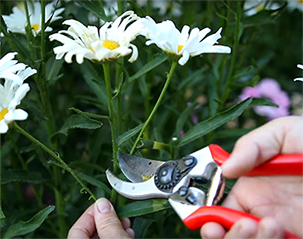
Like all Superbells®, they both will do best in containers or in-ground beds with great drainage.  Regular applications of fertilizer are key to keeping Superbells® looking great throughout the summer.  They perform best when placed in full sun locations, where the plants receive more than 6 hours of direct sun a day.  If your Superbells® start to look a bit bedraggled in midsummer, trim them back with a sharp pair of scissors or shears and give them an extra shot of fertilizer and they should quickly start putting on a show again.

If you like bright colors, the new Flirtation® Orange Diascia is your gal.  What looks like a ton of bright orange flowers, turn this mounding-trailing plant into a true shot of color.  Diascia have good cold tolerance and if they are hardened off can tolerate short bursts of temperature even into the low 20's.  This makes Flirtation® Orange a great candidate for early spring and fall plantings.  She also has good heat tolerance for a Diascia, however, once temperatures stay in the upper 70's at night she will struggle to bloom.  If you live in an area with lower night temperatures in summer, she should bloom planting to hard frost.  If you are in an area with high summer night temperatures, she may go out of bloom.  However, once the night temperatures fall, she will bounce back into bloom.  If she does go out of flower, give her a slight overall trim and she will look fantastic when she begins blooming again.   I love to contrast bright orange against blue for a great pop of color. 

If you like the contrast of blue and orange, but prefer your color to come from flowers, not paint, try using Lucia Dark Blue Lobelia mixed with Flirtation® Orange Diascia.  Not only will the colors of the plants mix well, they like the same conditions.  Provide at least 4 hours of direct sun a day - afternoon shade in warm climates would be helpful, water as needed and fertilize regularly and they will be happy campers.  Lucia Dark Blue will also have a tendency to slow down or stop flowering with hot night temperatures, but she too will come back into bloom when night temperatures fall.

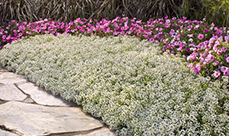
As much as I love all of our new introductions (they are outstanding), if I had to choose only one to grow again hands down it would be Snow Princess Lobularia.  Brand new plants are notoriously hard to find in garden centers, but she is well worth tracking down.  Some of you may think you already know how she will perform based on other Lobularia (also called sweet alyssum) you have grown.  This leads me to a question.  When is a Lobularia not really a Lobularia?  The answer, when it is really Snow Princess

If you live in a climate with warm summers your experience with sweet alyssum probably goes something like this, you plant it in early spring and the lacy white flowers are gorgeous and fragrant.  Along comes June, the mercury rises and the plants fry and die.  Snow Princess has honest to goodness heat tolerance, large clean white flowers and great fragrance to go along with a ton of vigor (she keeps up with Supertunia® Petunias!).  I have reports of her blooming all summer and winning awards in Georgia, Texas, and Mississippi, plus other, less hostile spots!  She maintains the same cold tolerance and fragrance you are used to.  Here she is in photos taken in July and August (left to right) in Kansas, Ohio, and Ontario, Canada.

Superbells® Yellow 'USCAL53002' US PPAF, Can. PBRAF; Superbells® Lavender 'USCAL56501' US PPAF, Can. PBRAF; Flirtation® Orange 'Dala Oran' US PPAF; Can. PBRAF; Lucia Dark Blue 'USLOB0901' US PPAF; Can. PBRAF; Snow Princess 'Inlbusnopr' US PPAF; Can. PBRAF; 

Readers Rated This: 12345 (3.5)
Back to Top