| The Complete Guide to Landscaping a Two-Sided HedgeThe challenge: You’ve decided to take the plunge and plant a new hedge. When starting from scratch, there are a number of things to consider like orientation which will affect how much sun or shade the hedge will receive, as well as details like irrigation, plant spacing, timing and more. We’ll show you how to landscape a two-sided hedge step-by-step and maintain it through the years using the Limelight Prime® panicle hydrangea hedge pictured here to illustrate. |
7-Step Guide to Landscaping a Two-Sided Hedge
Click any step below to see details.
| |  | |

Establish the BasicsTo get started, consider the basic growing conditions for your new hedge first. If it will run east to west like the Limelight Prime® panicle hydrangea hedge in this project, there will be a sunnier south-facing side and a shadier north-facing side to your hedge. You’ll choose the plants to landscape your two-sided hedge based primarily on sun or shade requirements. Next, consider the watering situation. Will you be able to irrigate the plants in your hedge? Is your soil very well-drained so it doesn’t stay moist for long, or is it heavier clay and tends to stay wet for a while after it rains or is irrigated? The hedge in this project is planted in well-drained sandy loam soil and is watered by an automatic sprinkling system three to four times per week. Another factor to consider is animal browsing. If deer or rabbits are frequent visitors to the place where you plan to grow a hedge, you’ll want to choose deer resistant shrubs like those in our Deer Proof™ program. Deer fencing and animal repellents are helpful, too. The hedge in this project is not affected by animal browsing. | 
The bed for the hydrangea hedge in this project measures 30 feet long and 6 feet wide. |
|
 Measure and Size the BedTo choose the right shrubs for a hedge and avoid the need for major pruning down the road, it is critical to measure the bed and size it accordingly. If the shrubs you choose will mature to six feet wide, for example, make the bed six feet wide from the start or even wider if you plan to grow flowers or perennials along the edges. If you’d rather wait and widen the bed as the shrubs mature, make sure there is room to do so in the planning stages of the project. |

Determine the Best Time to Plant Your HedgeIf you live where summers are very hot or the growing season is short, timing will be an important factor in your plants’ successful establishment. In warmer climates where winters are fairly mild, fall is an ideal time to plant perennials, shrubs and trees in landscaped hedges. Where the growing season is short, spring planting will give your plants more time to get established before the ground freezes again in late fall. Keep in mind that landscaping your two-sided hedge doesn’t have to happen all in one year. You might plant the shrubs for your hedge in the fall the first year and plant perennials or flowers around it the next. In the hydrangea hedge pictured in this project, one-gallon size Limelight Prime panicle hydrangeas were planted in the fall, and all of the other plants were planted the following spring. As a result, the hydrangeas got a head start and grew much larger the following season. |

Choosing Shrubs to Form a HedgeIn step 1, you determined the sun or shade conditions, access to water and susceptibility to animal browsing. Now, you’ll use that information coupled with the aesthetics you are trying to create to choose plants for your hedge. Plants for Privacy HedgesIf your goal is to create privacy, consider using taller evergreen shrubs like arborvitae, juniper, false cypress or camellias to form the hedge. Densely branched shrubs like viburnum, lilac, privet and weigela can also create a measure of privacy. Plants for Decorative HedgesIf your goal is to grow a decorative hedge like the one in this hydrangea hedge project, other good candidates besides hydrangeas include roses, butterfly bush, deutzia, spirea, abelia, clethra and ninebark. Plants for Tightly Pruned HedgesFor a tightly pruned hedge, try boxwood or similar evergreens like Japanese holly, inkberry holly, pyracomeles or yew. |


Choosing Companion Plants to Landscape Around a HedgeWhen planting a two-sided hedge, it is likely that one side or end will be exposed to more sun than the other. In the case of the hydrangea hedge in this project, the front side of the hedge that borders the pathway faces south and is in the sun all day. The north-facing back side of the hedge which borders the lawn is shadier. Once the hydrangeas mature, they will fully shade the back side of the hedge. Evaluate the Sun/Shade SituationBefore you shop for plants to landscape your two-sided hedge, observe the space closely from end to end to determine the amount of sun it receives throughout the day. - If it receives more than 6 hours of sun per day in the afternoon, choose plants that can handle full sun.
- If it receives 4 to 6 hours of sun, choose plants for part sun to part shade.
- If it receives less than four hours of sun per day, choose shade plants as companions.
Learn more about exposure. | 
This east-west oriented hedge has a sunny south-facing side and a shadier north-facing side. Suitable companion plants were carefully chosen for both sides based on their exposure preference. |
|
PERENNIAL COMPANION PLANTSFor more permanent plantings, choose low growing perennials to plant around the base of your hedge shrubs as they mature. If you started with a narrow bed, you may need to widen it as the plants grow larger over time. On the sunny side of your hedge, you might consider planting low growing catmint, hardy ice plant, creeping phlox or sedum. In more shade, try coral bells, foamy bells, foamflower, hostas, brunnera and lungwort. | 
‘Cat’s Pajamas’ catmint (for sun) |
|
 How to Space Plants Properly for a HedgeYou will determine the proper spacing of the shrubs for your hedge based on the way you want it to look and function. Think about what you'd like your hedge to look like five or ten years down the road. Is your goal to create a solid wall of foliage you can’t see through, or are you aiming for a looser look that partially screens, but does not block, the view? Would you prefer to be able to see the distinct shapes of the shrubs once they are mature or do you want them to grow together into one continuous wall of greenery? To block a view or if you want the shrubs to interlace together as they grow, space them according to the lower number of the shrubs’ mature size range. For example, if the shrub is expected to grow 4 to 6 feet wide, space them a maximum of 4 feet apart. For a more see-through screen or if you want see the distinct shape of each individual shrub when mature, space them according to the higher number of the shrubs’ mature size range. Using the example of the shrub that grows 4 to 6 feet wide, space them a minimum of 6 feet apart. For the Limelight Prime hedge pictured here, six hydrangeas were planted 5 feet apart down the center of the bed which measures 30 feet long and 6 feet wide. Since this hydrangea is expected to grow 4 to 5 feet wide, the outline of each plant should still be visible and they should just barely touch when the hedge is mature. Additionally, there should be about 12 inches of space on either side of the hedge for more plants unless the bed is widened into the lawn area over time. | 
Limelight Prime® panicle hydrangeas
were planted five feet apart to create a solid hedge.
|
|
 Use Annual Plants to Cast ShadeConsider this scenario: your landscaped hedge will eventually be shaded on one side, but that area is sunny for now until the shrubs grow taller. In this case, if you decide to install shade-loving plants there at the start of the project, you’ll need to shield them from the sun temporarily so they don’t burn. Annuals with large leaves like Emerald Isle™ Alocasia and Island Giants® Colocasia can act as living umbrellas that cast some shade. In the hydrangea hedge in this project, the Limelight Prime hydrangeas will eventually cast enough shade to protect the shade-loving hostas and ferns planted behind them. In the meantime, Emerald Isle Alocasia was planted between each hydrangea to do the job. By year three, the hydrangeas should be tall enough to cast plenty of shade so the Alocasia will no longer be needed. |

|
|
 Expected Maintenance for a Hedge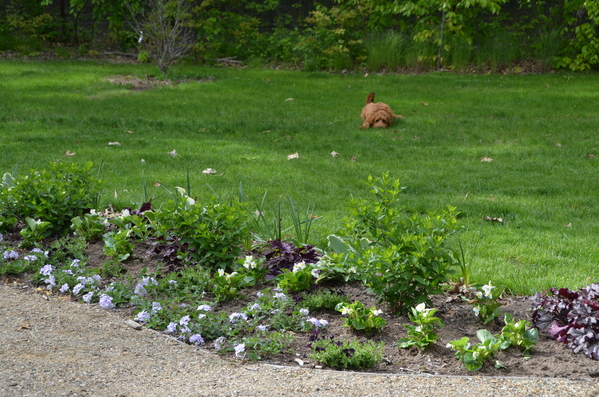
Our newly planted hydrangea hedge in spring. Once your hedge has been planted, watered and mulched, it should be as easy to care for as the other shrubs in your yard. You’ll water and feed it the same way and enjoy the progress as the plants fill in through the years. If you are growing a shrub hedge that needs pruning to keep its shape, such as a boxwood or spirea hedge, add that garden task to your to-do list and complete it around the same time each year. If you are going with a more natural look or using shrubs that don’t require much pruning to keep a tidy shape, less maintenance will be needed. For the Limelight Prime panicle hydrangea hedge in this project, the annual maintenance schedule includes the following tasks: - Freshen up the bed with a 2 to 3 inch layer of mulch around the shrubs each spring.
- Check the irrigation heads that supply water to the bed each spring to make sure they are still reaching all of the plants as they grow larger.
- Prune the panicle hydrangeas back by one third and remove any remaining dried flowers still clinging to the stems in early spring. Late fall to early winter is also an acceptable time to prune this type of hydrangea.
- Clean out any perennial foliage remaining in the bed after the winter, such as old hosta leaves.
- Feed the hydrangeas in early spring, just as the ground begins to thaw in cold climates, if desired. A granular rose fertilizer works well for this task. You may also fertilize monthly through late July for more rapid growth, but this is not necessary for healthy growth or abundant flowers.
- Plant new annuals around the shrubs each spring, if desired.
- Pull any weeds that pop up in the bed. Applying mulch and filling in empty spots with additional plants can help tremendously in reducing weeds.
|
|
Maturing Hedges Through the SeasonsOne of the greatest joys of gardening is watching plants grow. You’ve carefully planned, planted and maintained your newly landscaped hedge – now it is time to enjoy the fruits of your labor. Whether you tweak it a bit through the years or simply plant and leave it be, your hedge will serve its intended purpose for decades to come. If you’ve chosen hedge plants with multi-season interest like the Limelight Prime panicle hydrangeas in this project, you’ll have the added pleasure of enjoying their evolution from season to season. Enjoy this look at our Limelight Prime panicle hydrangea hedge from the beginning to the end of the project. Check back again next year for an update as the shrubs mature further. 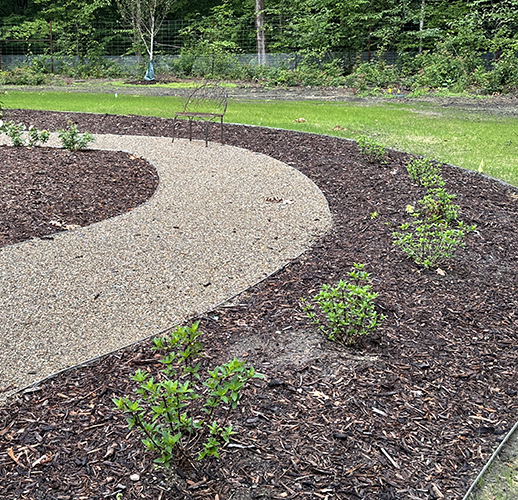
Year one, early fall - Newly planted hedge using one-gallon size Limelight Prime panicle hydrangeas. Proven Winners bulbs planted in late fall. | 
Year two, early spring – Hydrangeas are waking up, Proven Winners tulips and daffodils in bloom. | 
Year two, mid-spring – Companion annuals and perennials planted on both sides of the hydrangea hedge.
| 
Year two, early summer – Panicle hydrangeas beginning to fill in, with annuals starting to spread on the sunny side of the border. | 
Year two, midsummer – Panicle hydrangeas beginning to bloom and take center stage. | 
Year two, late summer – Panicle hydrangeas taking on pink tones. | 
Year two, early fall – Panicle hydrangeas flush deeper red tones that will persist through fall. Companion plants make the hedge full and robust. | 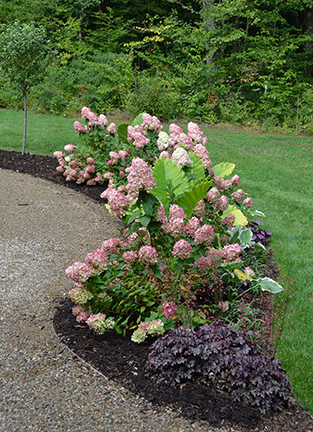
Year two, mid-fall – Most annuals removed for the season, fresh mulch laid to cut down on weeds. |
|
|
Hydrangea Hedge Plant Lists
Foundation shrub: Limelight Prime® panicle hydrangea (H. paniculata)
Sunny south-facing side: Superbena® Stormburst verbena, Supertunia Mini Vista® Midnight petunia, Emerald Isle™ elephant ears (Alocasia)
Shadier north-facing side: Surefire® White begonia, Pegasus® begonia, ColorBlaze® Wicked Witch™ coleus, ‘Crested Surf’ Japanese painted fern (Athyrium), Dolce® ‘Glazed and Infused’ coral bells (Heuchera), Dolce® ‘Wildberry’ coral bells, Shadowland® ‘Hope Springs Eternal’ hosta.
Learn more about hedges: